Cardboard Is Maked as Recycled
What is Cardboard Recycling?
Paper-thin, also referred to as corrugated cardboard, is a recyclable material that is recycled by minor and big calibration businesses to save money on waste disposal costs. Cardboard recycling is the reprocessing and reuse of thick sheets or stiff multilayered papers that accept been used, discarded or regarded equally waste.
Cardboard boxes are usually heavy-duty or thick-sheets of newspaper known for their durability and hardness. Examples of paper-thin include packaging boxes, egg cartons, shoe boxes, and cereal boxes.
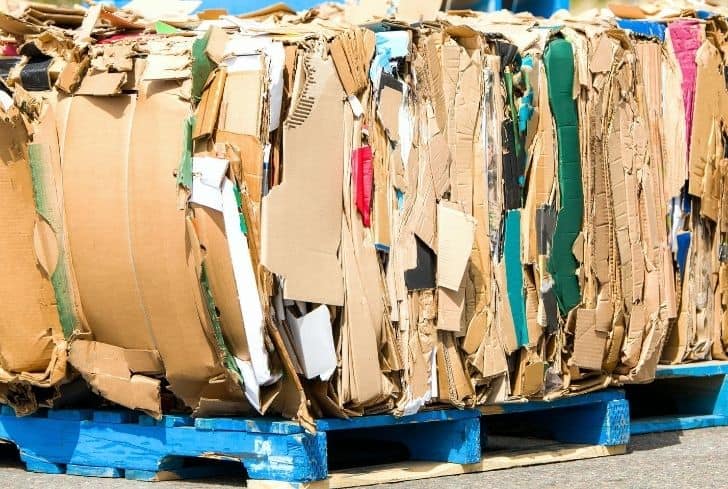
Thanks to my female parent, not a single paper-thin box has found its fashion back into club. We receive gifts in boxes from stores that went out of business twenty years ago.
~ Erma Bombeck
Recycling is practiced for usa as it not only saves our environment from deterioration past reducing pollution but also conserves valuable resources and creates jobs. Paper-thin recycling is washed equally a way of keeping the environment clean and green. The steps below provide an caption of the cardboard recycling organization.
Contents
- Pace-by-Footstep Process of Cardboard Recycling
- 1. Collection
- 2. Sorting
- 3. Shredding and Pulping
- 4. Filtering, Conterminal Removal, and De-Inking
- 5. Finishing for Reuse
- Advantages of Cardboard Recycling
- one. Saves Landfill Space
- 2. Environmental Conservation
- 3. Promotes the Use of Renewable Materials
- 4. Saves Free energy
- 5. Saves Trees
- six. Saves H2o
- 7. Creates Job Opportunities
- 8. Reduces Greenhouse Gases
- 9. Saves Resources
- ten. Durable
- 11. Source of Revenue
- Why Recycle Cardboard?
Step-by-Step Process of Paper-thin Recycling
1. Drove
"Collection" is the start step in recycling cardboard. Recyclers and businesses collect the waste paper-thin at designated cardboard collection points.
The bulk of the collection points include trash bins, stores, scrap yards, and commercial outlets that generate cardboard waste. Afterward collection, they are then measured and hauled to recycling facilities, mostly paper mills.
At this point, in that location are certain types of cardboard that are accepted, while some are non depending on how they were used or manufactured. For instance, cardboard that is waxed and coated or used for food packaging are not accepted in most cases as they undergo unlike specialized recycling process.
ii. Sorting
Once the corrugated boxes arrive at the recycling facility, they are sorted according to the materials they are made of. In most cases, they are classified into corrugated cardboard and boxboard. Boxboards are the ones that are thin such every bit those used for cardboard drink containers or cereals boxes.
Corrugated boxes are bigger and stiffer commonly used for packaging ship goods. Sorting is important since paper mills industry different grades of materials based on the materials being recovered.
3. Shredding and Pulping
Subsequently sorting is washed, the side by side step is shredding, and then pulping follows. Shredding is done to break down the cardboard paper fibers into minute pieces. One time the material is finely shredded into pieces, information technology is mixed with water and chemicals to breakdown the paper fibers that turn it into a slurry substance.
This process is what is termed as pulping. The pulped material is so composite with new pulp, generally from forest chips that ultimately help the resulting substance to solidify and become firmer.
4. Filtering, Conterminal Removal, and De-Inking
The pulp fabric is then taken through a comprehensive filtering process to go rid of all the foreign materials present as well equally impurities such as strings, tape or glue.
The pulp further goes into a chamber where contaminants similar plastics and metals staples are removed through a centrifuge-like process. Plastics float on top while the heavy metallic staples autumn to the bottom, afterwards which they are eliminated.
The next process, de-inking, involves putting the pulp in a floatation device made upward of chemicals that take abroad any form of dyes or ink via a serial of filtering and screening. This step is likewise called the cleaning process as it cleans the lurid thoroughly to ensure it is ready for the terminal processing stage.
5. Finishing for Reuse
At this stage, the cleaned pulp is composite with new production materials later which, it is put to dry out on a flat conveyor belt and heated cylindrical surfaces.
As the lurid dries, it is passed through an automated machine that press out excess water and facilitates the germination of long rolls of a solid sheet from the fibers called linerboards and mediums. The linerboards are glued together, layer past layer, to make a new piece of cardboard.
In other cases, the medium is used as the corrugated sheet, which is taken through two huge metal rolls with teeth to give it the ridges. Linerboards are then glued to the medium as the thin outer roofing.
Alternatively, the linerboards and mediums are ferried to boxboard manufacturers where the manufacturing procedure is completed past the utilise of machines that shape and create a crease along blueprint folds to brand the boxes used for packaging or transporting products.
Advantages of Paper-thin Recycling
1. Saves Landfill Space
Cardboard waste matter dumped in the landfill is about xl% of the total municipal waste. Paper-thin recycling helps to reduce the dumping of cardboard waste in landfills. One tonne of paper-thin saves more than 9 cubic yards of landfill space. On this basis, cardboard recycling helps to improve the cleanliness of the surroundings and promotes salubrious human surroundings.
2. Ecology Conservation
The paper-thin materials are 100% recyclable and biodegradable. Thus, it reduces environmental footprint and degradation by offering what is termed as "green" packaging solutions. Some cardboard is made from almost 100% recycled materials, while the majority is averaged at lxx% to ninety%.
Recycling cardboard also offers a fundamental solution to ecology conservation by preserving natural resource due to its highest reuse pct in producing new cardboard products.
3. Promotes the Use of Renewable Materials
The wood chips materials added during pulping are fabricated from birch or pino tree lurid that have a high percentage of recyclable content. Furthermore, these copse are easy to grow in diverse ecology conditions.
They are also first-growing compared to hardwood trees. Due to the fact that they can grow fast in various conditions and their recyclable quality, it means they can be managed and harvested sustainably, thereby promoting the use of renewable materials.
4. Saves Energy
Owing to the highest percentage of cardboard recyclability, the corporeality of energy required for producing corrugated packing products is tremendously reduced, and the saved energy tin be used in the manufacture of other resources.
Recycling cardboard requires only 75% of the free energy required to brand new cardboard. Recycling of cardboard requires 90% less water and l% less electricity needed to make them.
Further, they are made from locally available materials that can be harvested in an environmentally friendly way.
On this basis, the transportation and product costs of cardboard recycling are reduced while at the same fourth dimension excelling at delivering materials of greater structural strength for packaging or protecting goods in transit. This means no extraneous materials and energy are needed to industry new cardboard boxes.
Every bit a result, recycling cardboard saves free energy and materials needed to brand new cardboard and also reduces environmental pollution.
5. Saves Copse
Cardboard and paper come from trees. Another positive impact of recycling cardboard on the surround is the reduction in the number of trees cut down each year. Deforestation has been a pregnant cause of global warming.
But with the latest applied science that informs cardboard recycling, the need to cutting down trees to produce more materials is reducing gradually, which is good for the environment.
Information technology is estimated that when one tonne of cardboard paper is recycled, about 12 to 31 trees are saved, which farther preserves the natural habitat and the ecosystem in full general.This, in turn, becomes benign to the environment and flesh as a whole. If a person recycles all the paper produced during i year, it saves virtually one tree from beingness cut down.
half-dozen. Saves Water
The process of making paper products like paper-thin from wood materials involves the use of a meaning amount of water. But, equally recycled cardboard had passed through the candy stage already, less water is needed for the production of new materials.
Recycling paper saves 80% of h2o compared to production from virgin fiber. In a nutshell, you are saving approximately 7000 gallons or more than 25000litres of water on every tonne of cardboard y'all recycled.
7. Creates Job Opportunities
Recycling creates a lot of job opportunities for people right from the collection of waste cardboard until the filled product reaches the market. This, in turn, adds to the economic stability and growth.
8. Reduces Greenhouse Gases
Since cardboard is biodegradable, it decomposes automatically. But sometimes it tin can emit harmful gases. And then if these are recycled, there is a considerable reduction of greenhouse gas emission.
Incinerating 1 tonne of newspaper produces up to 750 kg of carbon dioxide. Carbon dioxide (CO2) is one of the greenhouse gases that cause climate change.
In newspaper manufacturing, each time one tonne of virgin fibers is replaced by recycled paper and cardboard, 2.3 tonnes of CO2 equivalent are saved. Recycling also reduces water and air pollution by 35% and 74%, respectively.
Likewise, cardboard that is trashed at the landfill usually breaks down and releases a toxic greenhouse gas known as "methane." Methyl hydride is known to contribute 20 percent more to global warming than the event of carbon dioxide.
9. Saves Resources
Recycling one tonne of corrugated containers saves 390 kWh of energy, 1.1 barrels (176 liters) of oil, 6.6 million Btu's of energy, and 5 cubic meters of landfill. By recycling, the paper-cardboard industry could be supplied with almost 69% of the resources it needs.
10. Durable
Recycled cardboard does not lose durability or resistance. After recycling, corrugated cardboard remains of the same quality or properties and is also more economical.
11. Source of Revenue
Cardboard recycling can actually get a source of acquirement for yous, rather than a waste material hauling expense. It also can create a safer and more efficient work surroundings for your staff.
Why Recycle Paper-thin?
Recycling is skilful for our planet as it helps to conserve resources, create jobs and reduces pollution from the production of new materials. Big businesses also recycle items as role of their corporate social responsibleness programs, and information technology likewise helps them to save money on waste disposal costs.
Many of the states buy and then many items online; we have lots of cardboard boxes to dispose of. There are several ways to dispose of these items like:
Reuse: When you accept plenty of paper-thin boxes at your disposal, just use them for storage purposes. You can fifty-fifty brand toys for your kids from large cardboard size boxes. You can also use them equally containers to separate different items for recycling purposes.
Pass them: You can pass on big cardboard size boxes to your friends or relatives in case they are planning to shift home. Small cardboard boxes can be used to store items that are not used likewise ofttimes. Schoolhouse children can utilise these cardboard boxes for their schoolhouse projects.
Recycle: All those pieces of paper-thin boxes that you are not able to reuse for any reason, you lot may send them to the local recycling center. Cardboard is accustomed at virtually of the waste product recycling centers.
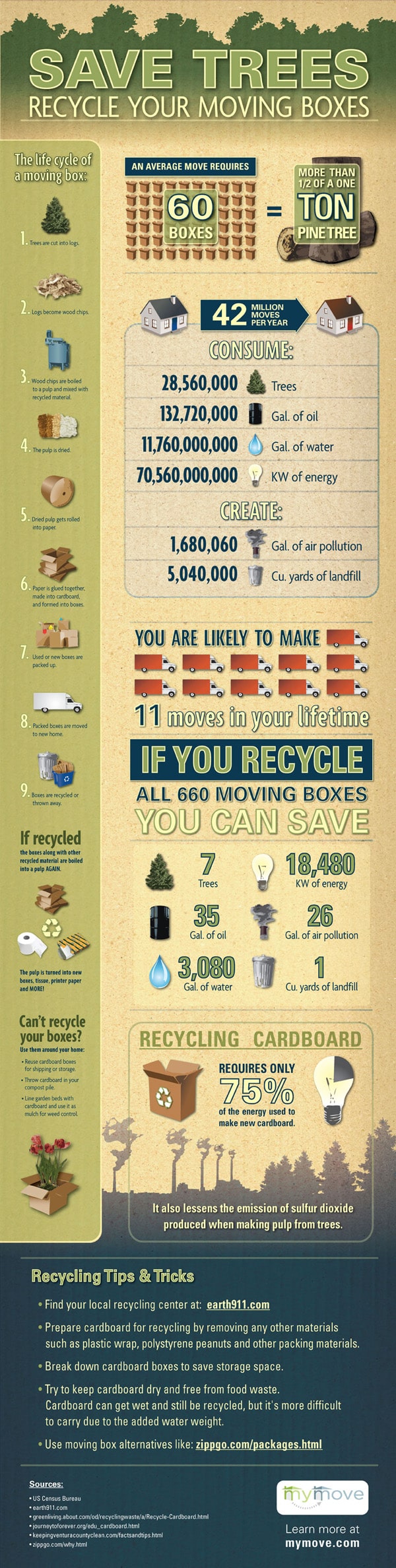
Here is a bully infographic on cardboard recycling from Earth911.
Source: https://www.conserve-energy-future.com/cardboard-recycling.php
0 Response to "Cardboard Is Maked as Recycled"
ارسال یک نظر